

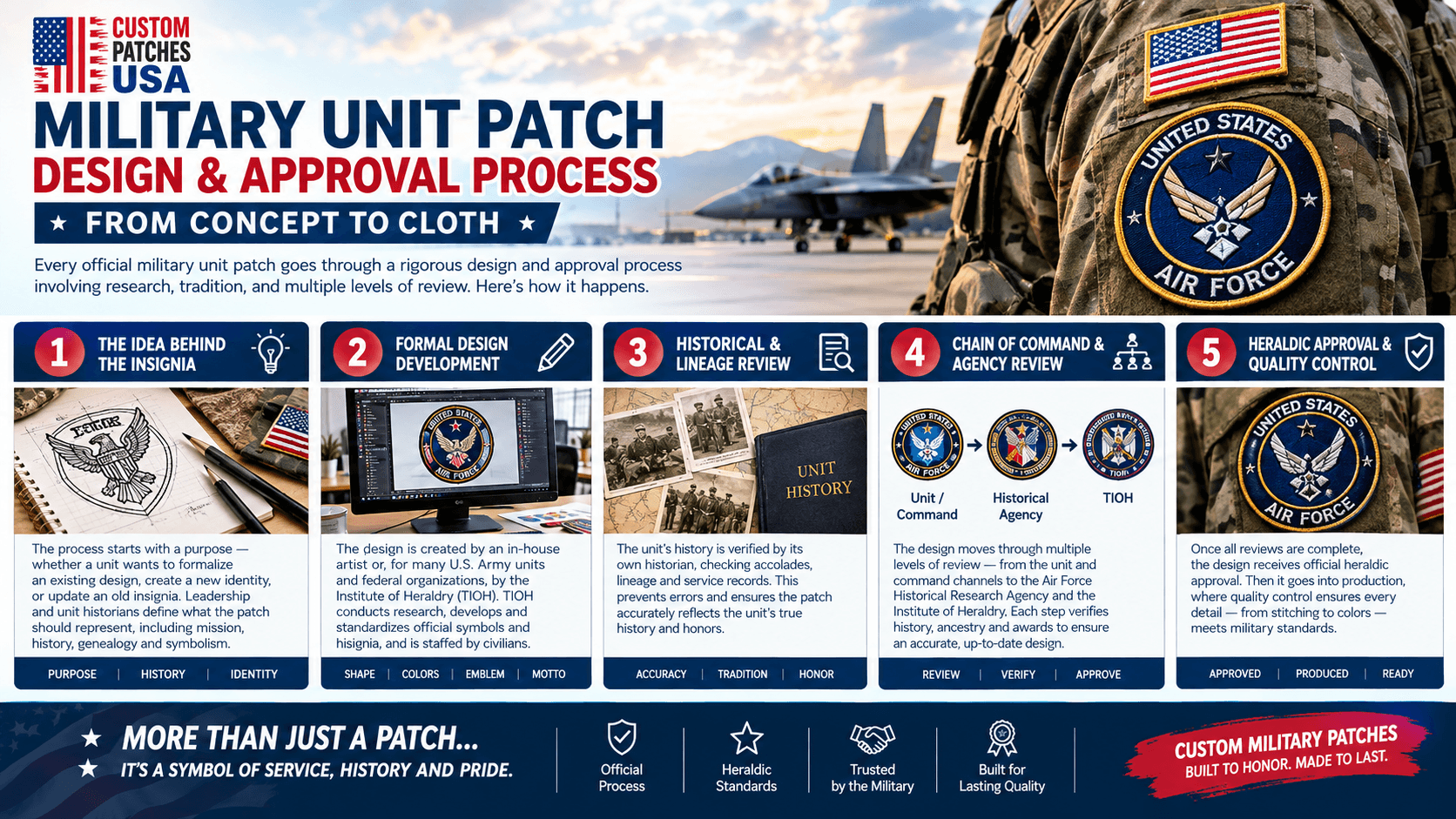
Before it ever touched fabric, every official military unit patch you’ve ever seen—the one sewn above a squadron’s flying suit pocket, the one worn with quiet pride by a battalion that has earned it, or the one on a general’s shoulder—went through a rigorous design and approval process. Designing military unit patches is a controlled procedure that requires heraldic inspection, historical study, and official government clearance. It frequently takes months for a design to be approved for production. This is a step-by-step account of that process and what it truly takes to transform an approved design into a patch that may be worn on a uniform for many years.
Stage One: The Idea Behind the Insignia
Every unit patch begins with a purpose, such as a squadron wishing to formalize a design that has been used informally, a freshly activated unit in need of an identity, or an organization upgrading out-of-date insignia to represent a new objective. At this point, the unit usually collaborates with its own leadership and, frequently, an assigned unit historian to determine what the patch should convey, including genealogy, mission, noteworthy history, and any symbolism associated with previous campaigns or honors.
This preparation is more important than it may appear. Heraldic symbolism dates back to the 12th century, when it was first used to identify individuals in combat. Over time, it developed into a means of telling a unit’s story and bringing its members together around a common identity. Heraldic design involves more than just choosing a color and an attractive animal.
Stage Two: Formal Design Development
After a unit has a clear concept, the design is created, either by an in-house artist who is knowledgeable in heraldic conventions or, more frequently for U.S. Army units and numerous federal organizations, by collaborating directly with The Institute of Heraldry (TIOH). TIOH is a small team based at Fort Belvoir, Virginia that conducts research, designs, develops, standardizes, and quality-controls official symbolic items such as seals, decorations, medals, insignia, badges, and flags authorized for official government use. Despite creating the iconic unit patches worn by senior officers across the Army and Marine Corps, TIOH is staffed entirely by civilians rather than active-duty service members.
The procedure usually begins somewhat differently for Air Force units in particular: an artist either creates a completely new patch when a new squadron is activated or modifies an existing patch design in accordance with written instructions. This stage creates the real visual design, including the shape, color scheme, center emblem, and motto if relevant, regardless of the branch or procedure involved. However, at this stage, the design is still a suggestion rather than an authorized insignia.
Stage Three: Historical and Lineage Review
The unit’s history must be verified before any heraldic body approves a design. This stage, which usually begins with examination and approval by the unit’s own historian before the design proceeds further up the chain, verifies claimed accolades, confirms lineage, and cross-checks the unit’s actual service record versus what the design implies.
This step is necessary because, in addition to being an embarrassing error, a patch symbol that refers to a combat honor, campaign streamer, or historical lineage that the unit did not truly win misrepresents the unit’s actual service history to everyone who sees it worn.
Stage Four: Chain of Command and Historical Agency Review
Before receiving ultimate heraldic clearance, the design must pass extra stages of examination after passing the historical evaluation. This usually implies that for Air Force units, the design proceeds in the following order: first to the major command or equivalent of the unit, then to the Air Force Historical Research Agency, then to the Institute of Heraldry, and finally back to the historical research agency for finalization. The purpose of the real-time procedure is to verify and cross-check history, ancestry, and awards to provide each unit with an accurate design.
Similar layered logic is used by Army units, which typically go through unit and command channels before arriving at TIOH for formal heraldic design and approval. The Institute of Heraldry is given authority by federal statute and regulation that governs the display of military insignia, the requirements for issuance, and the manner in which insignia are worn on uniforms.
Stage Five: Heraldic Approval and Quality Control
At this point, a design officially stops being a proposal and becomes an accepted patch. The idea at this point, according to Institute of Heraldry personnel, is to create patches that symbolize much more than just color and thread, something the unit can truly feel proud to wear. Before the design passes this stage, it must be supplied digitally and color-converted into officially approved uniform color palettes for Air Force patches in particular.
The unit can order patches directly from a certified manufacturer after development is officially approved and the relevant command point of contact is informed. For anyone looking to source patches for a design that has been approved, this information is crucial: official shoulder patches are considered quality-controlled heraldic objects that cannot be purchased until development samples have received official approval.
Stage Six: Turning an Approved Design Into a Production-Ready Patch
Heraldic approval encompasses the design, including the proportions, colors, and symbolism. Even for an officially recognized symbol, it does not address the manufacturing execution, which is where material and construction choices actually count.
Thread and construction quality. Most approved unit patches are produced as standard embroidered patches, employing a stitch technique and thread density that can precisely replicate the dimensions and color separations of the approved design. Even if a design has passed heraldic assessment, it still requires accurate digitization to convert an authorized digital depiction into real stitched thread without sacrificing detail at the patch’s ultimate production size.
Versions in full color as opposed to muted ones. For tactical and field use, many approved designs call for a muted-tone, subdued variant with the same proportions but a different, less noticeable color scheme, in addition to a full-color version for formal uniforms. To prevent design drift between the two, both versions must be made using the same authorized standard.
Small font and fine detail. Sometimes complex crest parts, microscopic text, or unit mottos are more elaborate than normal embroidery thread can produce at reduced scale. For designs with this degree of specificity, woven patches reproduce fine text and detailed heraldic elements with far more clarity than standard embroidery allows, since woven construction uses much finer thread at significantly higher density.
Resilience in the field. Sometimes units used in muddy, rainy, or high-abrasion situations specify PVC patches for field-use insignia, since molded rubber construction resists moisture and fraying in ways that stitched thread eventually can’t under sustained harsh conditions.
Border and backing. Approved unit patches typically use a merrowed (rolled, stitched) border for durability, and backing choice follows uniform context — sew-on for dress uniforms, Velcro (hook and loop) for tactical uniforms where insignia may need to move between gear configurations.
Stage Seven: Production and Ongoing Consistency
Maintaining exact consistency across all reorders becomes crucial once a certified manufacturer produces an approved design. This involves matching color, proportion, and construction exactly to the original approved specification, term after term, deployment after deployment, so that every patch worn across a unit matches regardless of when it was produced.
How Long Does Approval Actually Take?
There’s no single fixed timeline, since it depends on the complexity of the unit’s history, how many review layers a given branch requires, and current workload at the reviewing agencies. What’s consistent across branches is that the process is intentionally thorough rather than fast — historical verification, command endorsement, and heraldic design review each take real time, and rushing any one of them risks an inaccurate or non-compliant design reaching production. Units planning a new patch, whether for a newly activated organization or a redesign of existing insignia, generally do best treating this as a months-long process from initial concept to final clearance, not a quick turnaround request.
Common Reasons Designs Get Sent Back
Delays can be avoided by being aware of the reasons behind rejected or returned ideas. One of the most common problems is symbolism without a documented historical grounding, such as a design feature that alludes to an honor, campaign, or lineage claim that cannot be cross-referenced with the unit’s real service record. Since uniformity throughout a branch’s whole patch system is just as important as the uniqueness of any particular design, color or proportion selections that deviate from accepted heraldic traditions for that branch are another frequent source of contention.
Additionally, drawings that are submitted without the necessary digital format or color specification for the review process are particularly pertinent when it comes to the digital, color-palette-specific needs. Even after the design has been theoretically approved, Air Force review can still stall at the technical review stage. The best method to prevent these delays is to collaborate closely with the unit historian and heraldic point of contact from the very beginning of the project.
Producing Your Unit’s Approved Insignia
Whether your unit’s design has just cleared formal heraldic approval or you’re reordering an established insignia that needs to match an existing standard exactly, production quality matters as much as the design approval itself. At USA Patches, we produce embroidered, woven, and PVC patches with the color accuracy and construction precision that official military insignia require, in both full-color and subdued versions.
Browse Embroidered Patches for standard unit insignia production, Woven Patches for detailed crests and fine text, or PVC Patches for rugged field-ready versions. Order Patch Samples to verify material and color accuracy before a full unit order, or contact our team for a free custom quote on producing your unit’s approved design.