

Chenille Patches Trend: Why They've Taken Over Varsity & Streetwear Jackets
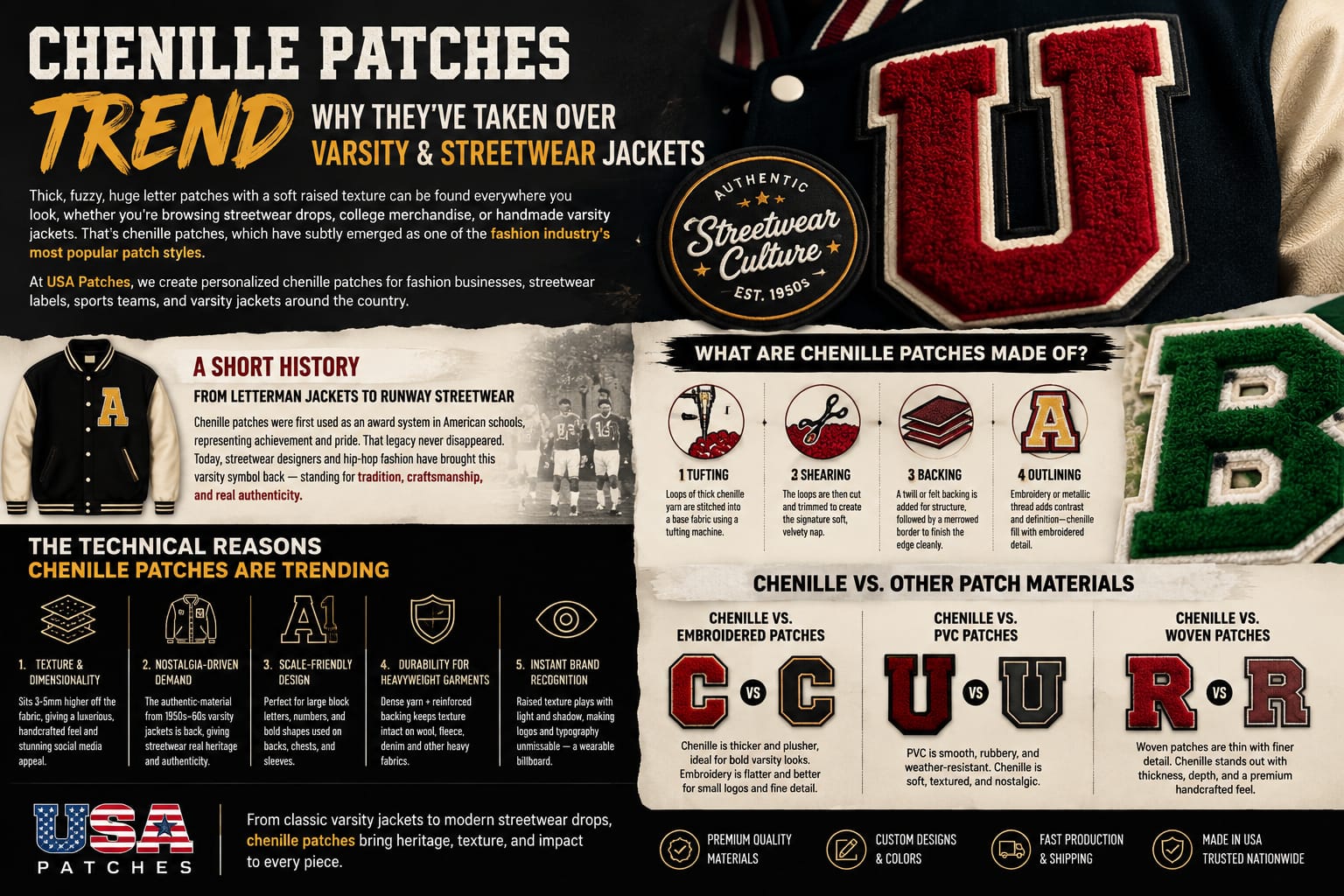
Thick, fuzzy, huge letter patches with a soft raised texture can be found everywhere you look, whether you’re browsing streetwear drops, college merchandise, or handmade varsity jackets. That’s chenille patches, which have subtly emerged as one of the fashion industry’s most popular patch styles. This trend is not coincidental. Streetwear businesses are currently renewing a decades-old relationship with varsity culture, as well as the material itself and the manufacturing process.
At USA Patches, we create personalized chenille patches for fashion businesses, streetwear labels, sports teams, and varsity jackets around the country. This is the actual material breakdown that explains why chenille is popular right now and how it stacks up against other kinds of patches.
A Short History: From Letterman Jackets to Runway Streetwear
Chenille patches were first used as an award system rather than as a fashion fad. Students who received a varsity letter in athletics, band, or academics in American high schools and universities throughout the middle of the 20th century were given a huge chenille letter to sew onto a wool jacket. The letter’s size, color, and placement made it clear what the wearer had accomplished, and the jacket itself became an outward symbol of both individual and school pride.
Even tho PVC, screen printing, and embroidery dominated apparel branding for many years, this symbolism never quite disappeared from mainstream fashion. Thanks to streetwear designers, sneaker culture, and hip-hop fashion, the varsity silhouette and its chenille writing are currently making a deliberate resurgence. Companies are using chenille in a market full with flat-printed logos because it represents tradition, craftsmanship, and traditional authenticity—not because it’s simpler or less expensive.
What Are Chenille Patches Made Of?
The French word for “caterpillar,” chenille, is an appropriate name for the fluffy, tufted yarn used to create these patches. Compared to PVC molding or embroidery, the construction technique is truly different:
- Tufting — Loops of thick chenille yarn (often a wool, acrylic, or rayon blend) are stitched into a base fabric using a tufting machine, similar to how a rug is made.
- Shearing — The loops are then cut and trimmed to create the signature soft, velvety, brush-like nap.
- Backing — A twill or felt backing is added for structure, followed by a merrowed border to finish the edge cleanly.
- Outlining — Fine embroidery or metallic thread is often added around the edges or on top of letters for contrast and definition; this is why many chenille patches combine chenille fill with embroidered detail.
Compared to traditional flat embroidery, the outcome is a thick, soft, three-dimensional patch with far more surface texture and depth.
The Technical Reasons Chenille Patches Are Trending
1. Texture and dimensionality
Chenille patches sit much higher off the fabric—usually 3–5 mm of elevated pile—than embroidered or printed patches. This tactile, sculptural quality not only gives clothing a luxurious, handcrafted feel that flat patches cannot equal, but it also produces great social media photographs.
2. Nostalgia-driven demand
The same material used to show school initials and accomplishment letters on American varsity and letterman jackets in the 1950s and 1960s is known as chenille letter patches. This varsity aesthetic is being purposefully revived by streetwear and fashion labels, and authentic chenille construction is what gives the look authenticity rather than cheap imitation.
3. Scale-friendly design
Chenille is particularly well-suited to huge block letters, numbers, and bold graphic shapes since it is tufted rather than stitched line-by-line. This is precisely the gigantic “collegiate” lettering used on jacket backs, chest patches, and sleeve insignia in contemporary streetwear.
4. Durability for heavyweight garments
Chenille’s texture-preserving requirements are met by its dense yarn structure and reinforced backing, which work well on heavier fabrics like wool-blend varsity jackets, fleece, and denim—garments that are usually not laundered as frequently as everyday clothes.
5. Instant brand recognition
On the back or chest of a jacket, a huge chenille logo patch serves as a kind of wearable billboard. One of the main reasons streetwear companies employ chenille for flagship drops and limited releases is that the raised texture catches light and shadow differently than flat prints, making logos and typography more visually noticeable.
Chenille vs. Other Patch Materials
Chenille isn’t a replacement for every patch type — it fills a specific niche:
- Chenille vs. embroidered patches: Standard embroidery is flatter and better for small logos and fine detail, whereas chenille is thicker, plusher, and better for strong, enormous letters. See our Embroidered Patches line for detail-heavy designs.
- Chenille vs. PVC patches: PVC is made for tactical and outdoor equipment and is shiny, waterproof, and stiff. Soft and fabric-based, chenille is designed for clothing and fashion rather than weather resistance. Compare with our PVC Patches.
- Chenille vs. woven patches: While chenille emphasizes texture and scale over fine detail, woven patches use fine thread density for lifelike detail and small writing. See Woven Patches for high-detail designs.
Design Considerations: Getting the Most Out of Chenille
Creating for chenille requires a somewhat different method than creating for embroidery or PVC because it performs so differently from thread or molded rubber:
- Maintain basic, bold letterforms. Large block letters, numbers, and basic shapes are Chenille’s strong points. Once the yarn is tufted and sheared, fine linework, tiny script fonts, and thin serifs often lose their definition.
- For contrast, use metallic or embroidered outlines. A chenille letter is surrounded by a tiny embroidered border that sharpens the edge and keeps the pattern from appearing blurry against the jacket fabric.
- When sizing, take pile height into account. Patches around embroidery-only items, such as little text or logos laid nearby, require a little additional room because chenille sits 3–5 mm proud of the surface.
- Make a placement decision based on the structure of the garment. Varsity and letterman-style jackets’ chest, back, and sleeve panels are designed to withstand the weight and thickness of chenille; T-shirts and other thinner clothing are typically not the best options.
- Consciously match the color of the yarn. If a design combines chenille lettering with an embroidered logo, color matching between the two materials should be verified at the mockup stage—something our design team does prior to production—because chenille yarn absorbs dye differently than embroidery thread.
Best Uses for Chenille Patches
- Varsity and letterman jackets (chest letters, sleeve numbers, back emblems)
- Streetwear jackets, hoodies, and denim
- College and university merchandise
- Team and club apparel with a retro-collegiate look
- Fashion-forward brand collaborations and limited drops
Backing and Application Options
Chenille patches can be finished with the same backing options as other patch types:
- Sew-on — the most common and durable method for jackets, recommended for chenille’s weight
- Iron-on / heat seal — works for lighter chenille patches on suitable fabrics
- Adhesive backing — best for temporary placement or sample approval before permanent attachment
Getting Chenille Patches Made
Compared to normal flat embroidery, the manufacturing process for chenille patches involves more setup because they entail tufting, shearing, and frequently mixed embroidery detail. The entire procedure is managed internally at USA Patches, including:
• Free digital prototypes before manufacturing.
• Minimal order quantities.
• Yarn and outline thread color matching that is customized.
• Quick turnaround and possible bulk pricing.
Explore the full Chenille Patches collection, browse Patch Samples to feel the texture difference for yourself, or request a free custom quote to start your varsity or streetwear jacket project.