

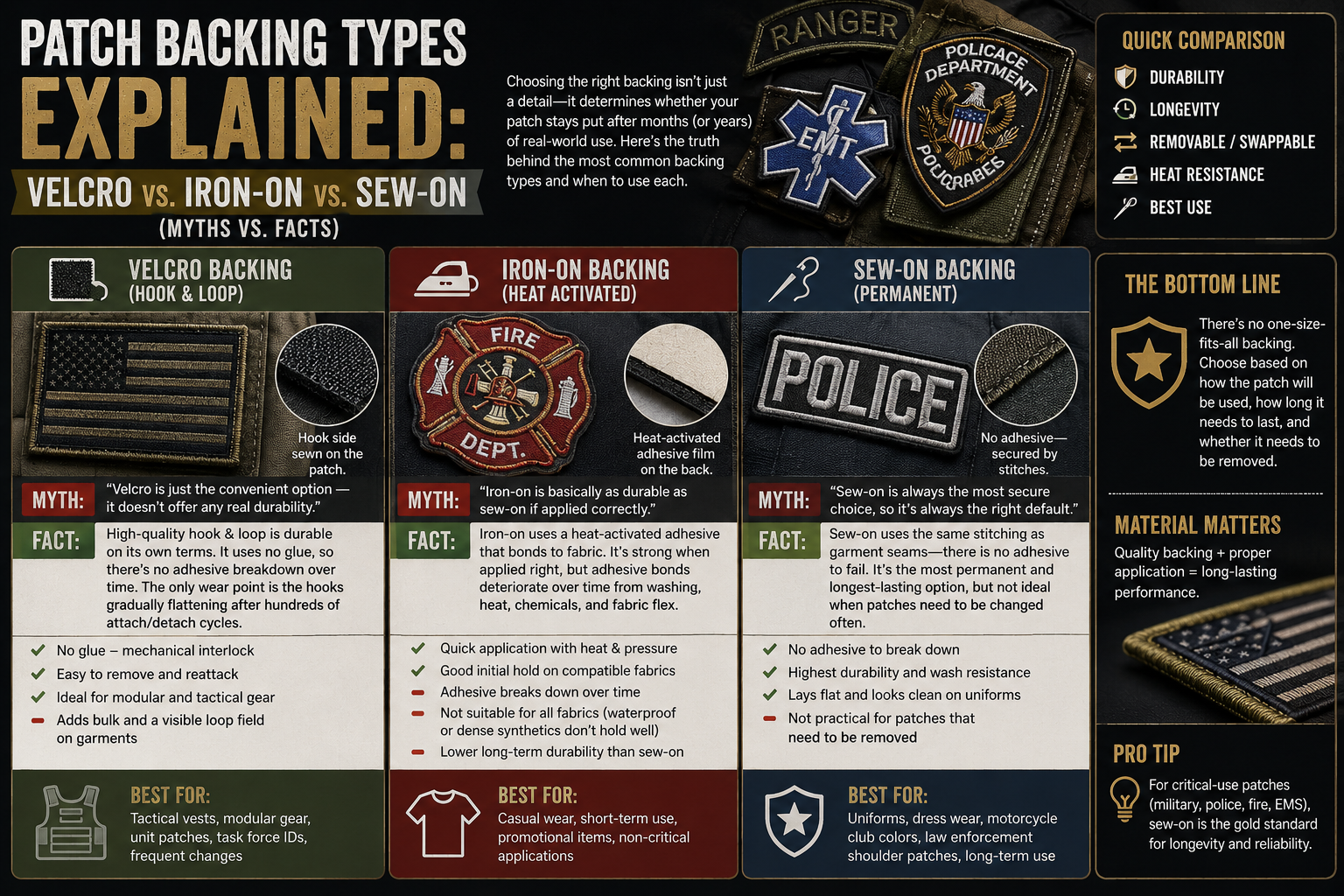
Most patch orders consider backing type as an afterthought, even though it’s one of the choices that will most likely decide whether a patch remains on the garment after a year. It’s also one of the most misinterpreted aspects of the procedure; we frequently hear the same few presumptions, most of which are at best just partially accurate. Here is a myth-versus-fact analysis of what Velcro, iron-on, and sew-on backings actually accomplish, the material science underlying each, and which one truly fits uniform use in military, motorcycle, and law enforcement applications, rather than a typical overview.
Myth: “Iron-on is basically as durable as sew-on if applied correctly.”
Fact: Because of the way the two techniques actually adhere to fabric, even a well put iron-on patch has a lower long-term durability ceiling than sew-on.
Iron-on backing functions by bonding a heat-activated adhesive film, usually a thermoplastic polymer, to the patch’s underside. The film melts and fuses into the foundation fabric’s weave under heat and pressure (typically 300–350°F maintained for 15–30 seconds), then solidifies as it cools to form the connection. This bond is quite strong when applied appropriately and on the appropriate cloth. However, it’s still an adhesive bond, and adhesive bonds deteriorate—more quickly with repetitive flexing at the patch edges, more slowly with heat cycling from washing and drying, and much more quickly on materials the glue doesn’t hold well in the first place, such as waterproof shells or densely woven synthetics.
There is absolutely no adhesive layer for sew-on backing to deteriorate. Simply said, it uses the same construction technique as the garment’s seams to mechanically hold two layers of fabric together. That’s why sew-on remains the standard for anything expected to survive years of wear, Embroidered Patches applied with sew-on backing routinely outlast iron-on versions of the identical design on identical garments.
Myth: “Velcro is just the convenient option — it doesn’t offer any real durability.”
Fact: In contrast to sew-on or iron-on backing, properly made hook-and-loop backing is actually durable on its own terms.
Velcro backing is made up of two distinct parts: a loop side, which is a looser woven nylon field sewed onto the clothing, and a hook side, which is made up of tiny, hard nylon or polyester hooks sewn into the patch. When the two are pressed together, they mechanically interlock; a well-built hook-and-loop system uses no glue at all, thus there is no adhesive deterioration to be concerned about over time. Hook wear—repeated attachment and detachment gradually flatten and break individual hooks, lowering grip strength over hundreds of cycles—is actually Velcro’s failure point rather than the bond itself.
This is a true functional advantage, not just a convenience, for uniform scenarios where patches actually need to move across clothing, such as tactical vests, modular gear, and task force assignments. Velcro backing is less prevalent on dress uniforms where a cleaner, flush profile is more important than swappability because it adds a little amount of bulk and a visible loop-field rectangle to the garment itself.
Myth: “Sew-on is always the most secure choice, so it’s always the right default.”
Fact: Sew-on isn’t just an unqualified strength; its permanence is the reason it’s not the best option in some uniform circumstances.
When a patch needs to move, sew-on’s greatest benefit—a permanent mechanical bond without an adhesive or hook-and-loop wear point—becomes a true drawback. Interchangeable identification, such as unit patches, rank, and agency badges that vary based on assignment, joint operations, or gear configuration, is a common feature of modern tactical and modular uniforms. Although sew-on is still stronger in raw bond terms, Velcro has emerged as the prevailing standard on tactical vests and outer carriers since it is impractical to re-sew a patch each time that identification needs to be changed.
Instead of asking “which backing is strongest” in the abstract, the appropriate question is “does this specific patch need to be permanent or does it need to move.” Dress uniform shoulder patches, traditional embroidered patches on service uniforms, and motorcycle club colors on a vest all fall firmly into the permanent category. Modular tactical gear and interchangeable identification fall into the other.
Myth: “Iron-on works on any fabric as long as you use enough heat.”
Fact: Certain materials just won’t adhere consistently with adhesive film at any temperature; thus, heat alone can’t make up for fabric compatibility.
Cotton, cotton-canvas, and cotton-blend denim are the most obvious examples of natural and natural-blend fabrics with an open weave structure that the melted glue can penetrate when using iron-on adhesive. Since the whole point of tightly woven synthetics, waterproof or water-resistant treated fabrics, and technical outdoor materials is to keep objects (including moisture and, consequently, adhesive) from seeping into the weave, they are designed to resist adhesive penetration. Instead of resolving the underlying compatibility issue, applying more heat to an incompatible fabric runs the danger of burning or warping the garment before the adhesive properly attaches.
This is one of the main reasons that iron-on glue is rarely advised for tactical, motorcycle, or duty uniform gear in particular, as a lot of such equipment is constructed from the precise type of technical, weather-resistant fabric that iron-on adhesive has trouble with.
Myth: “Backing choice doesn’t affect patch material choice — you can mix and match freely.”
Fact: Particularly with PVC, backing and patch material interact more than most people realize.
PVC patches bind to glue and thread differently than embroidered or woven patches because they are made of molded rubber instead of sewn fabric. Since sewing through solid rubber differs from sewing through woven cloth, reinforced stitch holes must be pre-formed into the mold for sew-on PVC patches. Because PVC has a smooth, uniform surface, iron-on PVC typically attaches well. It uses a heat-activated backing that is bonded to the flat underside of the molded patch. Because PVC’s stiff structure naturally complements a hook-and-loop method, which is the norm for the majority of morale patches and a significant portion of tactical unit patches, velcro PVC patches are incredibly popular. Browse PVC Patches to see the backing options available for this material specifically.
All three backing types are supported more interchangeably by woven and embroidered patches, which are constructed from stitched or woven fabric rather than solid rubber. However, the durability and use-case arguments mentioned above still hold true regardless of the fabric-based structure you select. See Woven Patches and Embroidered Patches for backing options across both.
Myth: “Adhesive peel-and-stick backing is just a weaker version of iron-on.”
Fact: Peel-and-stick isn’t a weaker iron-on; rather, it’s a completely distinct product designed for a different purpose, and comparing their endurance side by side would be inaccurate.
Peel-and-stick backing uses a pressure-sensitive adhesive that adheres on touch without the need for heat. This adhesive is conceptually comparable to a powerful sticker. It is truly helpful for only one purpose: temporary or semi-permanent insertion. This can be used for short-term applications that aren’t anticipated to withstand frequent washing or for testing patch arrangement before committing to permanent attachment.
Iron-on’s heat-activated bond is made with long-term wear in mind, which is a very different engineering objective. The majority of complaints about adhesive-backed patches breaking rapidly stem from treating peel-and-stick as a cheap iron-on and expecting iron-on-level durability from it; the product was never intended for that use case in the first place.
Which Backing for Which Uniform Context?
Combining the facts and misconceptions to provide useful advice for the three niches where this choice is most important:
Military uniforms are typically divided into two categories: Velcro for tactical and field uniforms, when rank, unit identification, or gear configuration must be changed without re-sewing, and sew-on for dress and service uniform insignia, where permanency and a neat profile are important. In order to match the uniform context on which they are worn, full-color and muted variants of the same patch frequently adhere to the same backing split.
The majority of motorcycle club colors are sew-on, which is more of a rigid convention than a flexible option. Velcro is typically only used for smaller, transient event or memorial patches rather than the core back patch and rocker set, and the permanence of sew-on attachment reflects the significance of colors within club culture. See Leather Patches and Embroidered Patches for the construction most riding clubs specify.
Police and first responder uniforms usually use the same reasoning as the military: Velcro is becoming more common on tactical vests and outer carriers for quick identification changes between assignments, while sew-on is used for normal dress uniform shoulder patches. In order to keep procurement easier at scale, departments that operate both types of uniforms frequently standardize backing option per uniform category rather than each individual patch.
Getting Backing Right on Your Next Order
Backing type isn’t a minor checkbox at the end of a patch order — it directly affects how long the patch lasts and whether it actually functions the way your uniform program needs it to. At USA Patches, we produce embroidered, woven, PVC, and leather patches with sew-on, iron-on, and Velcro backing options built to match real uniform requirements, not just whatever’s fastest to manufacture.
Browse Embroidered Patches, Woven Patches, or PVC Patches to compare backing options across materials, order Patch Samples to test backing durability firsthand, or contact our team for a free custom quote and backing recommendation based on your specific uniform application.