

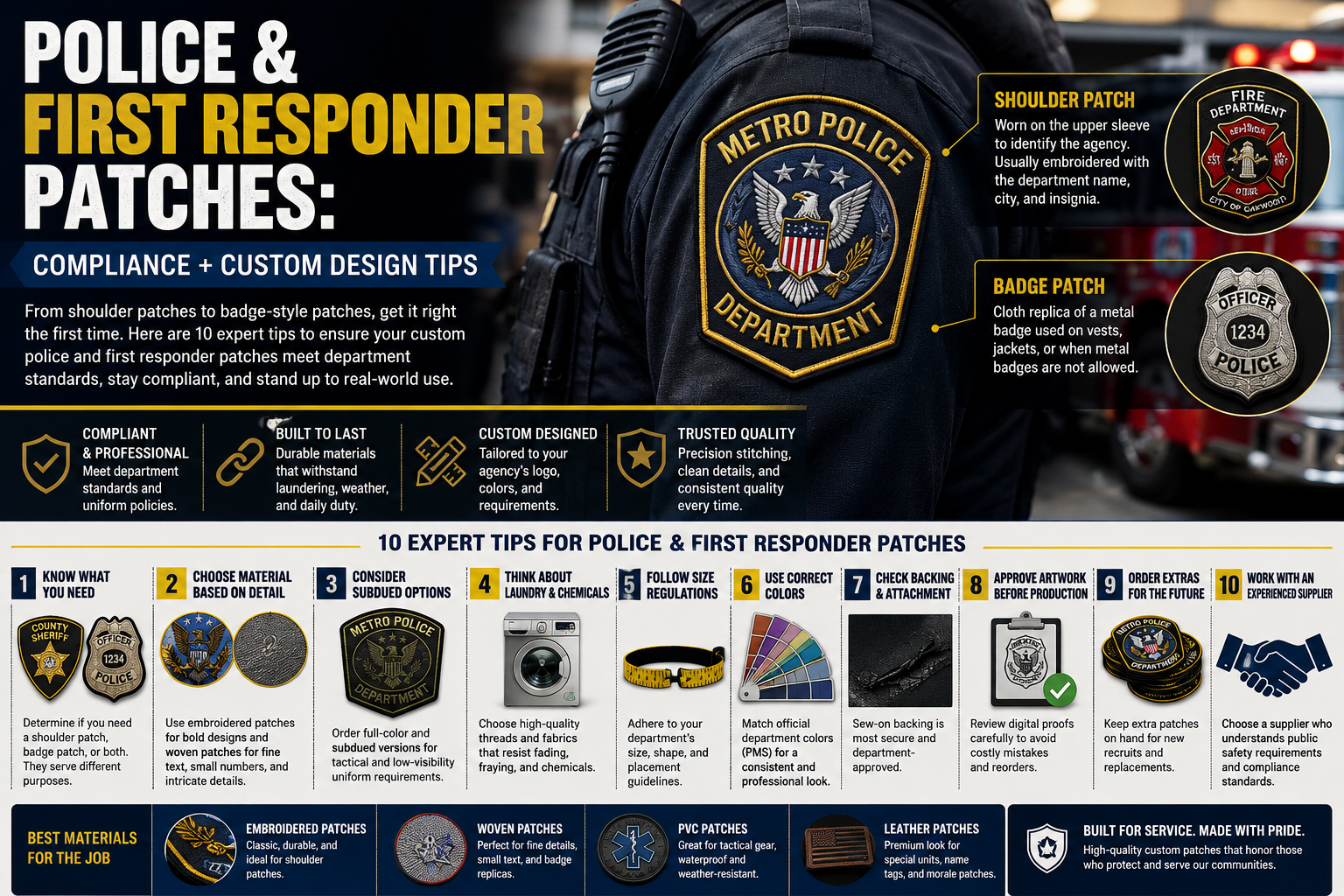
Patches for a sports team or streetwear brand are not the same as those for a law enforcement agency, fire department, or emergency medical services unit. Badge-style patches have legal and departmental significance, agency shoulder patches frequently need to closely fit current uniform criteria, and durability requirements are actually higher considering how frequently this equipment is laundered, exposed to the elements, and used in challenging situations. Instead of providing a broad overview, we would really lead a procurement officer or department administrator through these 10 particular, useful tips to ensure that custom police and first responder patches are done correctly the first time.
Tip 1: Know Whether You Need a Shoulder Patch, a Badge Patch, or Both
Mixing these two really separate products results in more reorders than any other error in this category.
Shoulder patches, which are worn on the upper sleeve of the uniform shirt or jacket, identify the agency itself. They include the department name, the city or county, and frequently a state or regional insignia. Since the format enables the reproduction of the agency seal or insignia with the classic textured appearance associated with police enforcement and fire service uniforms, these are nearly always embroidered. See our Embroidered Patches line for standard shoulder patch production.
In situations when a metal badge is impractical or prohibited, badge-style patches—typically cloth replicas of a metal badge design, may be utilized on outer tactical vests, jackets, or muted uniform variations. Because badge designs sometimes have fine lettering, minuscule numbering, and delicate border elements that must be readable at a reduced size, these demand more precise detail work than normal shoulder patches.
Before placing your order, find out which format is actually needed by consulting your department’s uniform policy. Many organizations mention both for certain uniform settings.
Tip 2: Choose Embroidered or Woven Based on Detail Density, Not Habit
This is the point at which material selection actually influences legibility rather than merely appearance. Bold agency logos, moderately detailed seals, and wider typography are all handled successfully by standard embroidered patches, which continue to be the standard choice for the majority of agency shoulder patches due to their thicker thread and richer stitch fill. However, normal embroidery thread is frequently too thick to maintain clean and readable details when a badge-style patch needs to replicate small badge numbers, delicate writing, or complex seal details at a reduced size.
This issue is precisely resolved using woven patches. Woven construction reproduces small text, badge numbers, and intricate symbol work considerably more clearly than embroidered stitching because it uses much finer thread at a much higher density. If the fine print or intricate seal on your badge patch design must remain sharp on a small scale, Woven Patches is almost always the better technical choice over standard embroidery.
Tip 3: Understand Subdued Patch Requirements for Tactical and Field Use
Many departments keep two versions of the same shoulder or badge patch: a muted-tone, suppressed version for tactical uniforms, outer carriers, or low-visibility field activities, and a full-color version for conventional dress uniforms. While maintaining the exact same design proportions and structure as the full-color original, subdued copies usually substitute olive drab, black, or muted gray tones for vivid golds, blues, and reds.
To ensure precise proportional consistency between the two, it’s worthwhile to order both versions from the same production run if your agency works in both standard and tactical uniform contexts. Approximating a subdued version separately later can introduce small design drift that a side-by-side comparison would detect right away.
Tip 4: Factor In Laundering and Chemical Exposure
In addition to possible exposure to cleaning chemicals, gasoline, smoke residue, and other chemical interaction while on the job, uniform patches for law enforcement and fire services undergo significantly more frequent industrial laundry than regular clothing patches. The choice of cloth and thread is significantly impacted by this.
When seeking a quote for uniform-grade patches, it is important to emphasize that high-quality polyester embroidered thread typically retains color and structural integrity better than lower-grade thread blends during repeated industrial washing, rather than presuming that all embroidery thread works identically. Since molded rubber composition cannot retain moisture or chemical residue the way thread and fabric can after repeated exposure, PVC patches offer real advantages for patches on outer gear subjected to more direct chemical or moisture contact, such as turnout gear accessories or tactical vest patches. Browse PVC Patches for gear that needs that level of chemical and moisture resistance.
Tip 5: Match Backing to Uniform Type
In this category, backing choice is typically determined by universal standards rather than being only a preference. Nearly all standard dress uniform shoulder patches are sewn on, offering the secure, long-lasting attachment required for a formal duty uniform. Velcro (hook and loop) backing is becoming more and more common in tactical vests, outer carriers, and modular gear. This enables quick identification changes between assignments, task force operations, or joint agency deployments without having to re-sew gear every time. Before placing an order, confirm your department’s unique policy because a typical and easily preventable procurement error is the wrong mixing of backing types across a uniform set.
Tip 6: Get Color Matching Right — It Matters More Than It Seems
When patches are worn side by side throughout a department, even slight color drift between an initial patch and a reorder can be seen. Agency colors frequently have particular meanings associated with department branding, rank distinctions, or regional identity. The chance of noticeable variance throughout a big uniform order is greatly decreased by requesting a physical or digital color reference before to manufacturing, such as an existing patch sample for direct comparison or a Pantone match if your department has one on file.
Tip 7: Consider Reflective and High-Visibility Elements for Fire and EMS
For low-light visibility, fire and EMS patches occasionally include reflective thread or trim elements, especially on turnout gear and outer jackets used in nighttime or roadside emergency response. Compared to a typical non-reflective patch, this is a specific manufacturing feature that should be identified early in the design process because it influences both the procurement of materials and the digitizing strategy.
Tip 8: Don’t Underestimate Small Order Flexibility
Specialized units, K-9 teams, honor guards, and smaller volunteer fire departments frequently require smaller production runs with the same quality standards as a major agency order, so not every department is ordering thousands of shoulder patches at once. The typical annoyance of a supplier that is only truly competitive at huge bulk quantities can be avoided by confirming minimum order quantities and per-unit price at smaller volumes up front.
Tip 9: Plan for Specialty Unit and Honor Guard Patches Separately
In contrast to the typical agency shoulder patch, K-9 units, SWAT and tactical teams, honor guards, and dive or bomb squad units often have their own specialty insignia, which frequently benefit from different material selections than normal uniform patches. Bold, graphic specialty unit emblems sometimes work well in PVC Patches for a modern, rugged look, while detailed unit crests with fine linework are often better suited to Woven Patches. Treating these as a distinct design and material decision, rather than defaulting to whatever the standard shoulder patch uses, usually produces a better result.
Tip 10: Request a Mockup Before Committing to a Full Order
Color matching, subdued versus full-color accuracy, fine text legibility on badge-style patches, and overall proportion should all be verified against a digital mockup prior to a full production run. This is especially true for large department orders, where a design error multiplied across hundreds of units becomes a costly issue rather than a minor one. The great majority of problems are detected before they are put into production with a free mockup step that costs nothing.
Tip 11: Don’t Overlook Border Finishing on High-Contact Patches
One minor aspect that significantly affects how long a uniform patch lasts is border style. Shoulder patches rub against radio straps, vest webbing, and equipment almost every day; a weak or hot-cut edge on a high-contact patch will show wear much sooner than one with a solid merrowed finish. A properly merrowed (rolled and stitched) border adds significant resistance to fraying on patches that see constant contact. Border width should be carefully defined for badge-style patches with fine detail near the edge to avoid crowding or obscuring small text or numbering close to the patch perimeter. This is another reason a mockup review prior to production might identify issues that a written spec sheet alone could overlook.
Ordering Custom Police & First Responder Patches
Choosing the correct material, color accuracy, and backing is crucial for both compliance and longevity in this area, whether you’re outfitting an entire department, ordering badge-style patches for a specialty unit, or replacing worn shoulder patches for an existing uniform program. At USA Patches, we produce embroidered, woven, and PVC patches with the precision color matching and construction standards that law enforcement and first responder uniforms require.
Browse Embroidered Patches for standard shoulder patches, Woven Patches for detailed badge-style designs, or PVC Patches for rugged, chemical-resistant tactical gear patches. Order Patch Samples to evaluate material and stitch quality firsthand, or contact our team for a free custom quote and mockup on your department’s next patch order.