

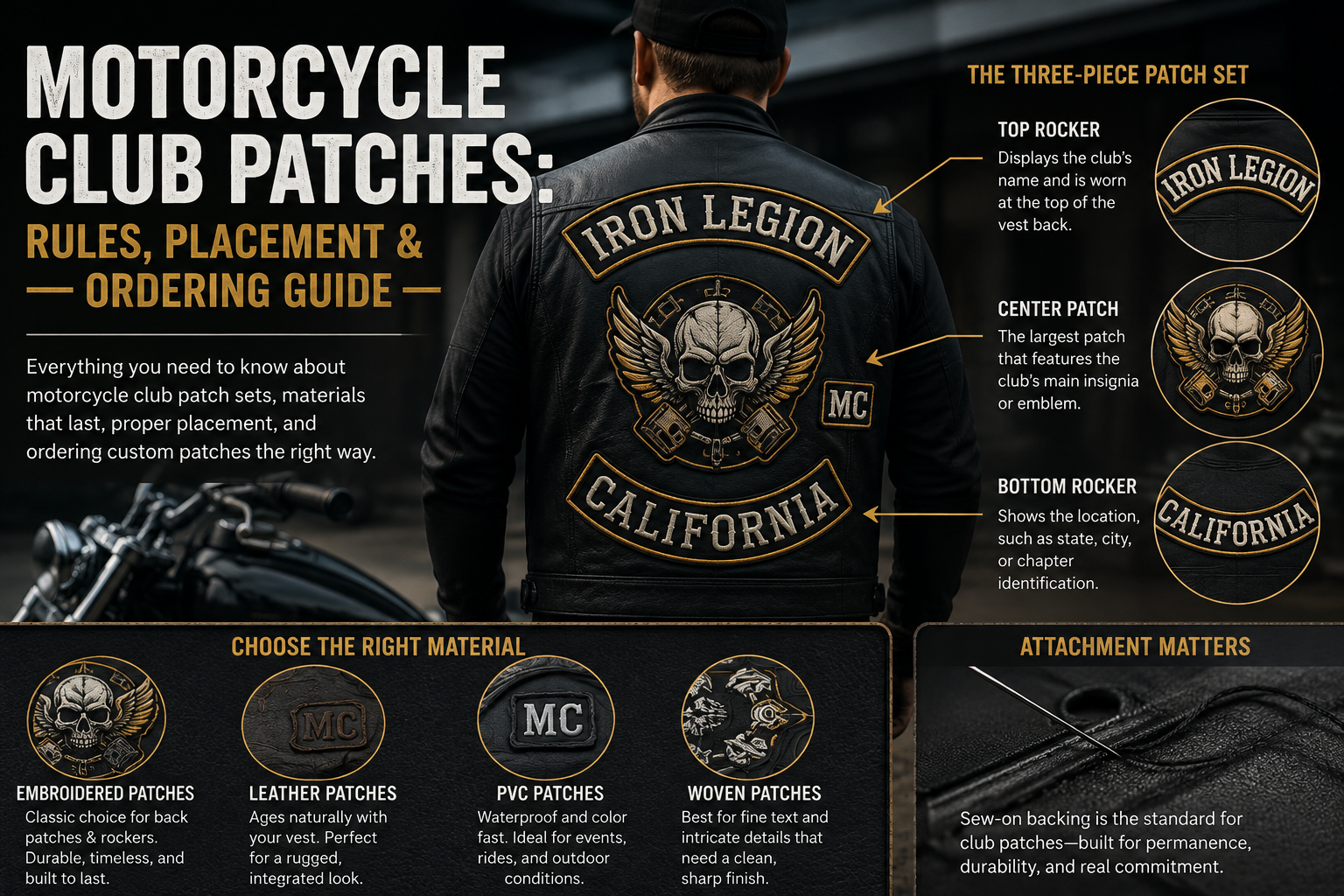
Over the years, we have created patches for enough riding clubs to know that this category has more unwritten regulations than nearly any other type of custom patch order. If you order the incorrect material for a leather vest, arrange it incorrectly, or don’t understand the significance of the three-piece patch set, you’re not just dealing with a design error; you’re dealing with something that has genuine significance inside club culture. Before placing an order for personalized motorcycle club patches, this tutorial explains the actual conventions, the materials that hold up on riding clothing, and other important information.
Understanding the Three-Piece Patch Set
Conventional motorcycle club “colors” begin with three distinct patches that function together rather than a single, expansive pattern. This structure has been consistent throughout club culture for decades.
· The club’s name is usually displayed on the top rocker, a curved patch worn at the top of the vest back. The term “Rocker” describes its curving, arc-shaped form, which rocks like a smile at the top of the back panel.
· The center patch, which is located in the middle of the back and features the club’s primary insignia or badge, is typically the biggest and most intricate of the three patches and the one that best represents the club’s visual identity.
· The bottom rocker, which lies beneath the center patch and reflects the curved shape of the top rocker, usually shows a place, such as a state, city, or chapter identification.
· These three patches together make up what’s commonly referred to as a “back patch” or “colors” set. The club itself usually chooses the exact mix, text, and graphic elements, adhering to any internal structure and customs that the organization upholds.
Material Choice: What Actually Holds Up on Riding Gear
This is where many generic patch suppliers fall short because motorcycle vests and jackets are subjected to a very demanding combination of conditions, including frequent flexing from riding position, wind exposure, rain, road grime, and UV exposure from extended outside hours. Not all patch materials are equally adept at handling that combination.
Embroidered patches continue to be the go-to option for back patches and rockers, and for good reason—the thick thread and twill backing structure has been shown to be durable for decades, especially on leather and denim vests. Even after years of exposure to wind and weather, a well merrowed border does not fray. See our Embroidered Patches collection for the classic construction most riding clubs specify for colors.
Leather patches are particularly worth taking into account for vest applications because leather patches naturally weather and age alongside a leather vest rather than appearing mismatched over time, and leather-on-leather placement creates a more integrated, seamless appearance than a fabric patch against a leather backing. Browse Leather Patches if you want that integrated, aged-in look for smaller patches, name tags, or supporting patches on a leather cut.
PVC (rubber) patches provide real benefits for smaller supporting patches, such as event badges, ride-specific patches, or memorial patches, when complete waterproofing is more important than conventional texturing. PVC retains color very well when exposed to the sun for extended periods of time on lengthy rides, but it won’t absorb road filth the way thread can. Check out PVC Patches for smaller accent patches that need to survive real weather without fading or fraying.
Woven patches are worth taking into account for smaller patches with fine writing or intricate emblem work, such as club insignia, small chapter designations, or memorial dates, when regular embroidery thread would be too thick to display the information neatly. See Woven Patches for that level of fine detail on smaller pieces.
Backing and Attachment: Sew-On Is Standard for a Reason
Sew-on backing is still the almost universal norm for motorcycle club colors, and it’s not just tradition for tradition’s sake, in contrast to many custom patch categories where Velcro has become the default for convenience.
Real dedication and identity within a club are represented by a back patch and rocker set, and sew-on attachment captures that permanence in a manner that a detachable Velcro patch just cannot. Another practical durability argument is that sew-on patches, when correctly stitched with heavy-duty thread through both patch and vest material, are significantly more resilient to wind, rain, and years of wear than adhesive or hook-and-loop bonds subjected to the same conditions over time.
While the basic three-piece color combination is nearly always sewed on and is meant to remain that way for the duration of the vest, smaller supporting patches, such as event badges, memorial patches, or temporary ride patches, occasionally use Velcro for practical flexibility.
Placement Conventions Worth Understanding
Before placing an order, it’s important to be aware of some commonly accepted basic standards, even though the specific regulations and their meaning differ by club and are ultimately decided by each organization’s internal structure and tradition:
The top rocker, center patch, bottom rocker configuration mentioned above is usually followed for placing the rear panel, which should be centered on the back of the vest and easily visible.
Front panel patches, such as name patches, rank or position patches, and smaller club-related patches, are often positioned on the chest in accordance with the internal arrangement of a particular club.
The size of the patches on the back panel is often proportionate to the vest itself, with the rockers sized to enhance rather than overpower the central patch, which serves as the visual focal point.
The most crucial step before placing an order is to confirm precise specifications, such as size, wording, curve radius on rockers, and color requirements, directly with the club’s own established guidelines rather than assuming a generic template applies, because placement carries real significance within club culture and every organization has its own specific standards.
Getting Colors Made: What to Have Ready Before You Order
When a few things are resolved beforehand, ordering a back patch set goes more smoothly. Both rockers’ exact phrasing and spelling were verified against the club’s own standards rather than being presumed. strict color specifications, as club colors frequently have specific meanings and must match exactly rather than somewhat. The size requirements for each of the three pieces should ideally be based on an existing vest or, if replacing worn colors, a previous patch set. Additionally, the majority of back patches include a merrowed border for durability; however, verifying this up front prevents delays.
Before committing to a full production run, a free digital mockup is really helpful since it allows you to verify rocker curve, center patch scale, and color correctness against the actual vest.
Memorial and Event Patches
In addition to core colors, riding clubs may order smaller patches for particular uses, such as guest and visiting patches for other clubs’ activities, anniversary and event patches for planned rides, or memorial patches honoring a member. These smaller patches have more design flexibility than core colors and are a good fit for any of the four main construction types depending on the design: bold graphic memorial designs often work well in PVC Patches, detailed emblem work suits Woven Patches, and classic text-and-emblem event patches fit naturally into standard Embroidered Patches. Many clubs order these smaller patches as annual or event-specific runs, so it’s worth budgeting for that as a recurring line item alongside the one-time cost of a full colors set.
Caring for and Replacing Worn Colors
A back patch set that has been used for many years has a unique tale to tell, and most riders don’t want to replace colors simply because they have faded or worn slightly—that patina is part of it. However, there are practical situations in which a replacement is required, such as a damaged vest, a patch that is irreparably ripped, or a chapter or location change that necessitates an updated bottom rocker.
Since uniformity in size, color, and text across a club’s colors is part of what makes them instantly recognizable to other riders, duplicating the original as nearly as possible is more important when replacing worn colors than most other patch categories. It is considerably simpler to match thread colors, rocker curve, and lettering style precisely when ordering a replacement if you have an old patch or clear images on hand instead of estimating from memory.
If you’re choosing materials for a first-time order rather than a replacement, it’s important to consider that embroidered patches with a correctly merrowed border and sew-on attachment typically outlast lighter-weight alternatives by a large margin for vests that are exposed to heavy weather.
Ordering Custom Motorcycle Club Patches
Whether you’re making a batch of memorial and event patches, replacing worn rockers, or outfitting an entire riding club with matching colors, choosing the appropriate material, construction, and placement is crucial for both road durability and accurately representing something that has genuine meaning within the club. At USA Patches, we produce embroidered, leather, PVC, and woven patches with the color accuracy and construction quality that riding club colors demand.
Browse Embroidered Patches for traditional back patches and rockers, Leather Patches for integrated vest-matched pieces, or PVC Patches for weatherproof event and memorial patches. Order Patch Samples to check material and stitch quality firsthand, or contact our team for a free custom quote and mockup on your next set of colors.