

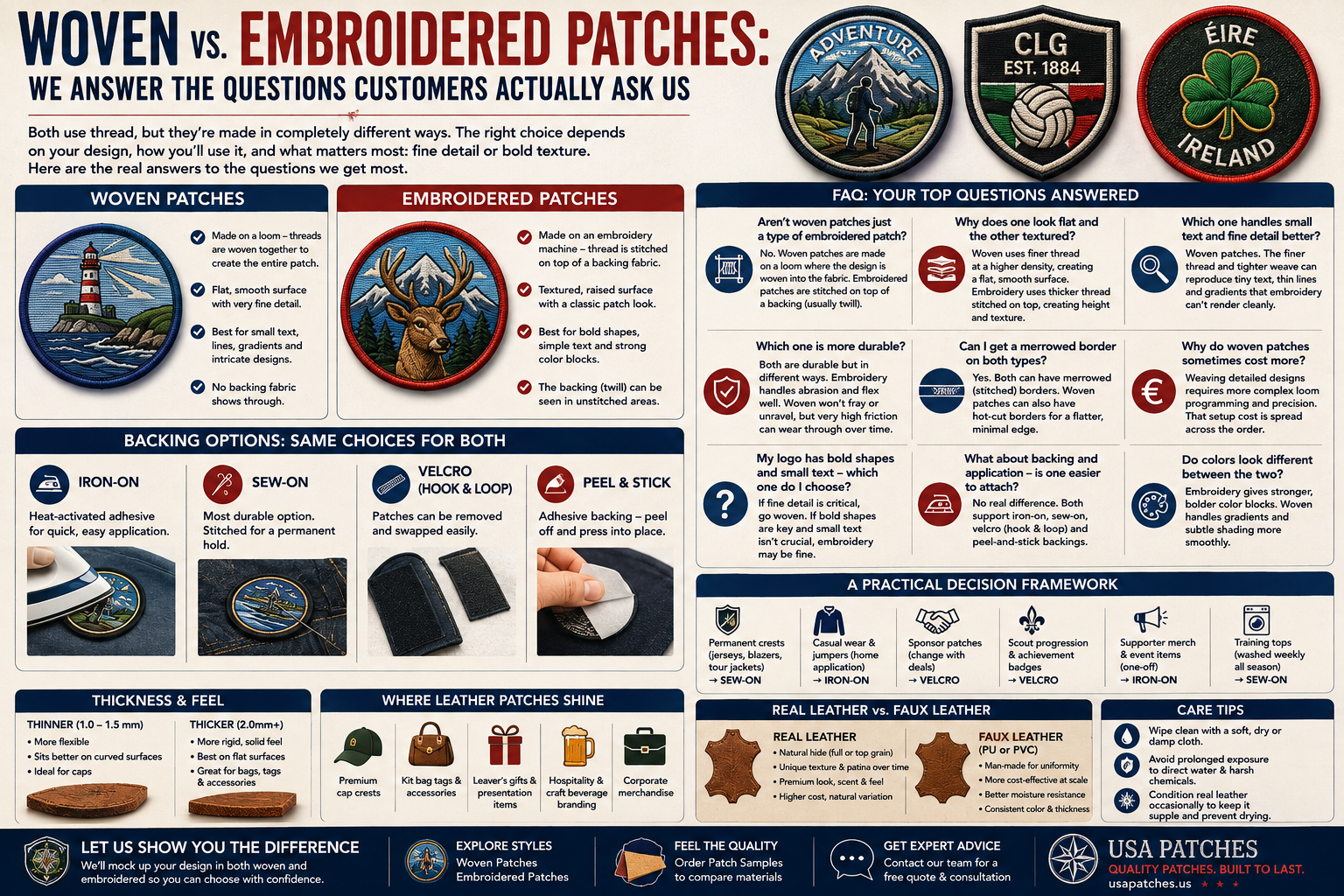
What’s actually the difference between woven and embroidered patches? is a topic that is posed in a dozen different ways every week. Because both styles employ thread, appear similar from a distance, and are routinely referred to as “embroidered” even though they are not, it’s one of the most confusing pairs in the whole custom patch category. Therefore, rather than creating another generic comparison article, we compiled the actual questions that our staff is asked most frequently and provided answers in the manner that we would explain them to a person standing at our counter.
Aren’t woven patches just a type of embroidered patch?
Technically, no. This is the most common mistake in the category. Using an embroidery machine, thread is sewn onto a pre-existing base fabric (often twill) to create embroidered patches. The foundation fabric comes first; the thread pattern is applied on top of it, and the twill backing appears as the patch’s backdrop in places that aren’t stitched.
In contrast, woven patches are created on a loom rather than an embroidery machine. The whole patch, including the design and backdrop, is created as a single continuous woven cloth by directly interlacing horizontal (weft) and vertical (warp) threads. Since the “backing” and the pattern are physically woven together as a single piece of cloth, no separate backing fabric is visible. That is not a modification of the same manufacturing process; rather, it is a fundamentally distinct one.
If you want to see this difference in person rather than just read about it, our Patch Samples let you feel both constructions side by side.
Why does one look flat and the other looks textured?
This is the most dependable method of visually distinguishing between stitch density and thread thickness.
In standard embroidery, a satin or fill design dense enough to completely cover the twill background is embroidered using relatively thick thread, usually 40-weight rayon or polyester. The recognizable textured, somewhat elevated surface of embroidered patches is a result of the thicker thread and the raised stitching that sits on top of the cloth.
Woven patches are woven at a considerably higher thread count per inch than embroidery stitch density permits, using much finer thread, often in the 60–120 denier range. The flatter, smoother surface created by the finer thread and tighter weave is more akin to a printed or screen-printed appearance, but it is made solely of interlaced thread rather than ink or dye. For PVC patches or chenille patches, the surface texture comes from an entirely different mechanism (molded rubber, tufted yarn), so it’s really only woven vs. embroidered where “flat versus textured” is the defining visual question.
Which one handles small text and fine detail better?
Not very near, and it’s woven. Woven patches may replicate minuscule writing, thin outlines, gradient shading, and lifelike detail that would simply become an unreadable blob if stitched with regular embroidery thread because they employ finer thread at a far higher density than embroidery stitching permits.
For band merchandise, small logo patches, gaming and esports team badges, and any design with lettering less than around a quarter-inch long, woven patches are the preferred option. Standard embroidered patches start losing legibility on fine text and detailed linework well before woven patches do, simply because the thread itself is too thick to represent that level of detail cleanly.
Which one is more durable?
Both are robust, but depending on your use case, they fail in different ways.
Patches on high-movement places, such as jacket elbows, backpack straps, or duty uniforms that are frequently worn, benefit greatly from embroidered patches’ wide thread coverage and twill backing, which make them more resilient to abrasion and repetitive flexing. Individual stitches may snag or rip away if they come into contact with something sharp, which can occasionally result in noticeable fraying at a stress point.
Since there isn’t a loose stitch to snag and pull, woven patches often withstand fraying and unraveling better than embroidery since they are made of a single continuous woven cloth rather than stitched-on thread. However, compared to the thicker, denser design of regular embroidery, their finer thread construction may render them somewhat more vulnerable to wear-through on continuous high-friction contact locations.
Both types last for years when used properly for the majority of ordinary clothing items, like as coats, hats, and purses. In heavy-wear, specialized applications, the durability difference becomes significant.
Can I get a merrowed border on both types?
Indeed, this is one of the few similarities between woven and embroidered patches. Both patch kinds come with a merrowed border, which is a tightly rolled, stitched edge that finishes the edge neatly and adds a tiny bit of structural support to prevent fraying. Because it doesn’t add visible bulk around delicate detail, the alternative, a hot-cut border, is preferred on smaller woven patches because it cuts the edge with heat that seals the material without an extra stitched rim. This results in a flatter, more minimum edge.
It’s important to provide your preferred border at the quote stage, regardless of the kind you’re purchasing. See our Embroidered Patches and Woven Patches collections for examples of both border styles in production.
Why do woven patches sometimes cost more?
The cost of raw materials is not as important as setup complexity. In contrast to setting an embroidery machine’s stitch pattern for a bolder, simpler design, programming a loom to weave an intricate design—especially one with gradient shading, small writing, or fine linework—requires more accurate digital mapping. The majority of the price difference is not due to the thread itself, but rather to the additional digitizing precision.
Because the setup costs are distributed across a larger number of units, the per-unit cost difference between woven and embroidered becomes much smaller at larger volumes. Regardless of quantity, conventional embroidery is frequently the more cost-effective option if your design is bold and straightforward; if it’s intricate and delicate, woven generally ends up being worth the slight price difference because embroidery just can’t replicate the same outcome.
My logo has both bold shapes and small text — which one do I choose?
This is really one of the most typical real-world design scenarios, and the truth is that it depends on which component is more important to get right. Embroidery may often effectively depict the bold form while simplifying or slightly increasing the little text if the fine text is a brief tagline that is more ornamental than necessary to understand. Woven is nearly always the safest option if the fine detail is functionally significant, such as a tiny wordmark, a serial number, or a complex symbol, as it can maintain both the bold shape and the fine detail without requiring a compromise.
Some customers completely mix tactics when a design truly requires both thick, tactile texture and extremely tiny detail in various spots, such as a woven patch with the primary pattern combined with a separate raised or 3D embroidery element, or a bold chenille patches letter alongside finer woven detail elsewhere on the same garment.
What about backing and application — is one easier to attach?
There isn’t much of a distinction here. The same backing options—iron-on, sew-on, Velcro (hook and loop), and sticky peel-and-stick—are compatible with both woven and embroidered patches. The garment and use case, not the type of patch fabrication, determine the backing technique. The same guidance applies whether you’re deciding between iron-on and sew-on for PVC patches, embroidered patches, or woven patches.
So which one should I actually order?
Go with embroidery if your design features dense letters, bold forms, or a traditional textured “patch” style. It is still the industry standard for team logos, military-style patches, and general clothes marking since it is the more conventional, tactile option.
Go weaved if your design includes photorealistic details, gradients, delicate typography, or anything smaller than a quarter-inch that must remain readable. It is the only sort of thread-based patch designed to retain that degree of information without sacrificing readability.
A free mockup is ideal if you’re actually unsure of which category your design belongs in; comparing the two possibilities to your actual artwork eliminates any uncertainty.
“Do colors look different between the two?”
A little bit, and it’s important to know before completing the artwork. Because of its thicker thread and greater stitch coverage, embroidered patches typically result in stronger, more vivid color blocks, which work well for basic palettes and solid-color logos. Because the fine thread is interlaced rather than layered in thick stitching, woven patches can manage gradients or shaded transitions that are typically difficult for embroidery to accurately replicate, as well as combine colors more softly. Neither is “better” for color in a strict sense; rather, it depends on whether your design makes use of subtle, intricate shading (the power of weaving) or flat, stark color blocks (the strength of embroidery).
Get a Free Mockup Before You Decide
You don’t have to choose blind. At USA Patches, our team can mock up your design in both woven and embroidered formats so you can see exactly how each handles your specific artwork before committing to an order. Browse Woven Patches and Embroidered Patches to compare styles, order Patch Samples to feel the material difference yourself, or contact our team for a free custom quote and design consultation.