

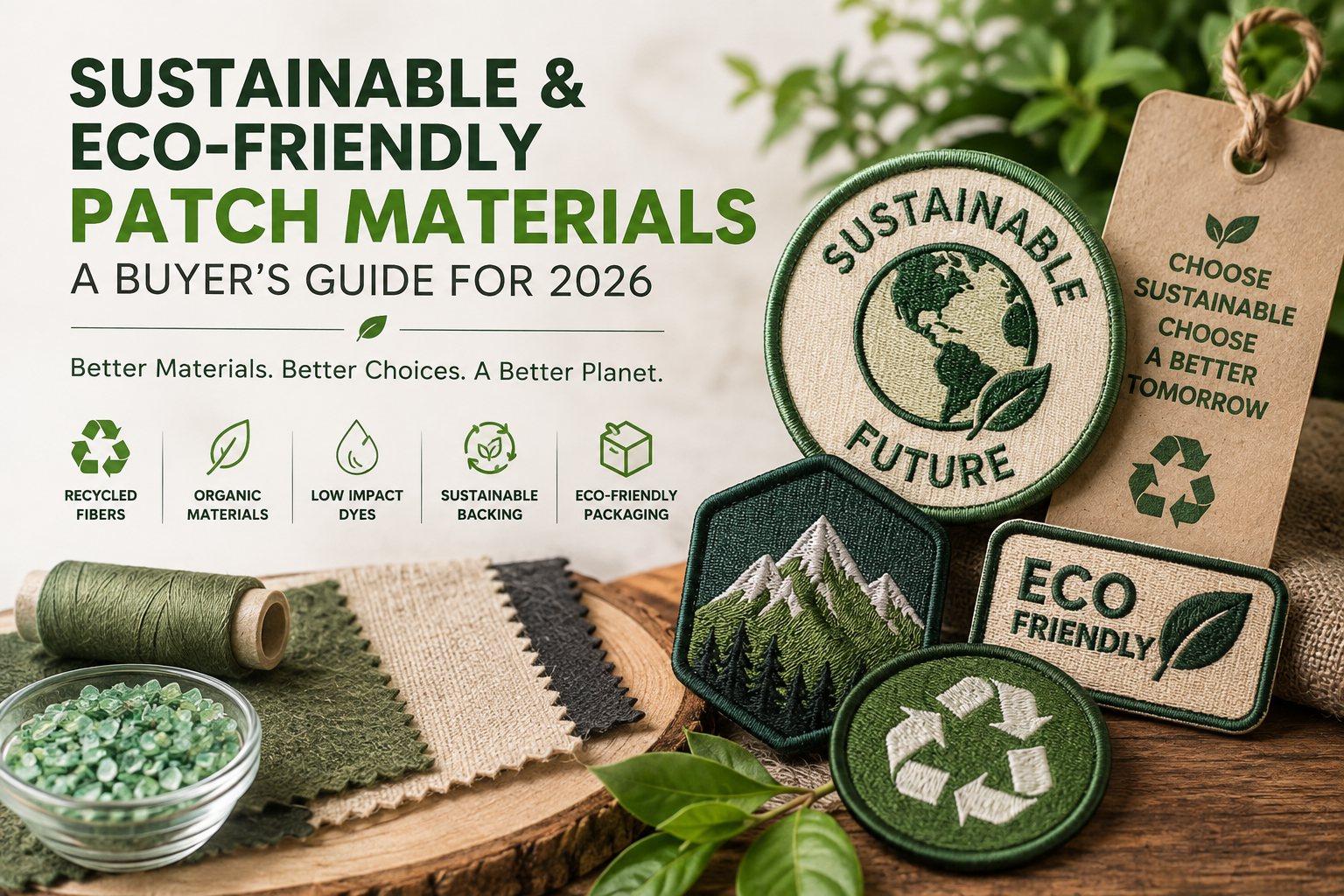
In 2026, “sustainable” will no longer be a soft add-on when obtaining unique patches for your business, team, or organization. Instead, it will be a legitimate purchasing consideration, along with price, turnaround time, and design accuracy. However, the majority of patch providers simply put the term “eco-friendly” on a product page without explaining the material, dyeing method, or the true differences in the backing. The purpose of this tutorial is to address that. If you read it before placing your next order, you’ll know exactly what to ask, which certifications are meaningful, and which patch materials actually lessen environmental impact rather than just sound nice in marketing language.
At USA Patches, every year, we receive more inquiries regarding sustainable options from organizations, schools, outdoor companies, and corporate uniform initiatives. Before selecting eco-friendly personalized patches, consumers should be aware of the following.
Step 1: Understand What “Sustainable Patch Material” Actually Means
Since there isn’t a single certification that includes all patch types, “sustainable” falls into some distinct categories that each buyer must assess separately:
· Fiber source: is the fabric or thread composed of recycled or organic materials, or is it made of polyester derived from virgin petroleum?
Is the dye and finishing procedure solvent-heavy and chemically intense, or is it water-based and low-impact?
· Backing and adhesive: is the backing made of a permanent plastic laminate or is it recyclable or biodegradable?
· Production waste: Is material use efficient by design, or does the manufacturing process produce a sizable amount of offcut waste?
· Shipping and packaging: Does the patch come in minimal or recyclable packaging, or is it wrapped in extra plastic?
A truly sustainable patch sequence typically makes improvements on multiple fronts simultaneously, rather than just one. Asking your supplier more insightful questions rather than taking a generic “eco” label at face value starts with understanding this breakdown.
Step 2: Know the Recycled and Organic Fiber Options
For embroidered patches, recycled polyester (rPET) thread is now the most popular environmentally friendly choice. It is produced by recycling post-consumer plastic, mostly PET bottles, into thread suitable for needlework. In terms of tensile strength, colorfastness, and stitch quality, rPET thread functions nearly identically to virgin polyester thread, making it the most convenient sustainable alternative for consumers who don’t want to sacrifice durability.
Another option is to use organic cotton backing fabric and thread, which is very important for customers who wish to completely eliminate synthetic fiber. GOTS (Global Organic Textile Standard) certification is the standard to check for if a seller claims organic sourcing; organic cotton is farmed without artificial fertilizers or pesticides. Cotton-based patches are more suited for interior clothing and soft-goods applications than tough outdoor gear because they feel softer and more natural, but they typically have lower tensile strength and water resistance than polyester.
Reprocessed polyester fiber is used to make recycled twill backing, which is becoming more widely available as the foundation fabric for woven and embroidered patches. This reduces dependency on the manufacturing of virgin textiles without altering the final patch’s look or feel.
The strongest combination now available at scale is rPET thread on recycled twill backing if you’re looking for custom embroidered patches with a reduced environmental impact without sacrificing durability. Browse the base options on our Embroidered Patches page and ask about recycled thread sourcing when requesting a quote.
Step 3: Understand Sustainable Alternatives for PVC and Rubber Patches
· In some patch applications, TPU (thermoplastic polyurethane) alternatives are showing promise as a less impactful alternative to conventional PVC. Although it usually costs more and isn’t now available in every shape and color option, TPU is more easily recyclable at the end of its useful life and avoids some of the chlorine-based pollutants associated with PVC manufacture.
Reduced-waste molding techniques are also important. Compared to older casting techniques, PVC patches made in effective, low-scrap molds produce less production waste per unit; this improvement is more related to manufacturing techniques than the raw material itself.
If your gear absolutely needs PVC’s waterproofing and durability but you want the lowest-impact version available, ask specifically about recycled-content PVC when browsing our PVC Patches options — it’s a smaller upgrade than switching fiber types entirely, but a meaningful one at volume.
Step 4: Look Closely at Dyes and Finishing
Although it is frequently overlooked in marketing materials, this aspect of “sustainable patches” is just as important as fiber selection. It’s important to comprehend low-impact alternatives to traditional textile dyeing, which can require a lot of water and chemicals:
· The most important label to look for in this situation is OEKO-TEX Standard 100 certification, which provides consumers with a tangible, third-party-verified standard rather than an ambiguous sustainability claim by confirming that a textile product has been tested for hazardous materials at every stage of manufacture.
· Long before the embroidery or molding stage even starts, reduced-water finishing techniques in twill and fabric preparation reduce one of the most resource-intensive procedures in textile manufacturing.
Step 5: Ask About Backing and Adhesive Materials
· Although backing is frequently the least sustainable component of an otherwise environmentally conscientious patch, it is easy to ignore. A petroleum-based hot-melt adhesive film, which is commonly used in standard iron-on backing, is not biodegradable and can make recycling the patch at the end of its useful life more difficult.
· Since sew-on backing just requires thread and fabric rather than an adhesive coating or plastic film, it is by far the most environmentally friendly attachment technique available. One of the easiest adjustments a shopper can make if sustainability is a major concern is switching from iron-on to sew-on.
· The middle has a Velcro (hook and loop) backing. Although the nylon components aren’t biodegradable, Velcro’s reusable and detachable nature prolongs a patch’s useful life across several clothes, thus offsetting some of its environmental cost.
Step 6: Factor In Production Efficiency and Order Quantity
Sustainability encompasses more than just raw resources; it also involves a supplier’s production and shipping efficiency. Here are some useful queries to pose to any patch manufacturer:
Does the mockup and digitization process reduce the number of wasteful sample runs before final production? Do patches made domestically have a lower carbon footprint and delivery distance than those made exclusively abroad? Instead of wrapping every product in extra plastic wrap, is there minimal or recyclable packaging? Are minimum order quantities fair enough to prevent purchasers from placing excessive orders and wasting inventory?
Purchasing the appropriate amount for actual needs from a provider with effective domestic manufacturing frequently has a greater environmental impact than switching to a single commodity.
Step 7: Match the Material to the Actual Use Case
The most sustainable patch is the one that lasts as long as the garment it’s attached to — a patch that fails early and needs replacing defeats the purpose of choosing an eco-friendly material in the first place. That means the greenest choice depends on application:
For indoor uniforms, corporate apparel, and soft goods, organic cotton or rPET-thread embroidered patches with sew-on backing typically offer the best combination of durability and lower environmental impact.
For outdoor, tactical, or weather-exposed gear, recycled-content PVC patches remain the more practical sustainable choice, since a patch that survives years outdoors avoids the environmental cost of repeated replacement even if the raw material itself is more resource-intensive than cotton.
For detailed logos and fine artwork, woven patches made with recycled thread offer high-resolution detail with a lower-impact fiber base than standard synthetic thread.
A Quick Note on Certifications Worth Trusting
Before making a purchase, it’s important to understand which certifications are genuinely meaningful because not every sustainability claim on a product page is supported by any reliable evidence. GOTS is especially applicable to processing norms and organic fiber content. Regardless of whether the fiber is organic or recycled, OEKO-TEX Standard 100 ensures that no hazardous materials are present at any point in the textile production process.
The most direct method of ensuring that a claim of recycled PVC or rPET thread is true rather than speculative is through Global Recycled Standard (GRS) certification, which confirms the actual percentage of recycled content in a material. Ask your supplier which of these, if any, apply to the particular materials in your purchase when you’re unsure. A provider who can provide specific information is typically a more trustworthy source than one who merely offers a generic “eco-friendly” label.
Getting Started with Sustainable Custom Patches
Choosing eco-friendly patch materials in 2026 means asking specific, informed questions rather than trusting a generic “green” label — fiber source, dye process, backing type, and production efficiency all factor into the real environmental footprint of a finished patch. At USA Patches, our team can walk you through recycled thread, sustainable backing, and low-impact dye options for your specific project, with free digital mockups and low minimum order quantities so you order exactly what you need.
Ready to explore sustainable options for your next order? Browse Embroidered Patches and PVC Patches for material specifics, check Patch Samples to feel the difference in fiber and finish firsthand, or contact our team for a free custom quote and sustainability consultation.